


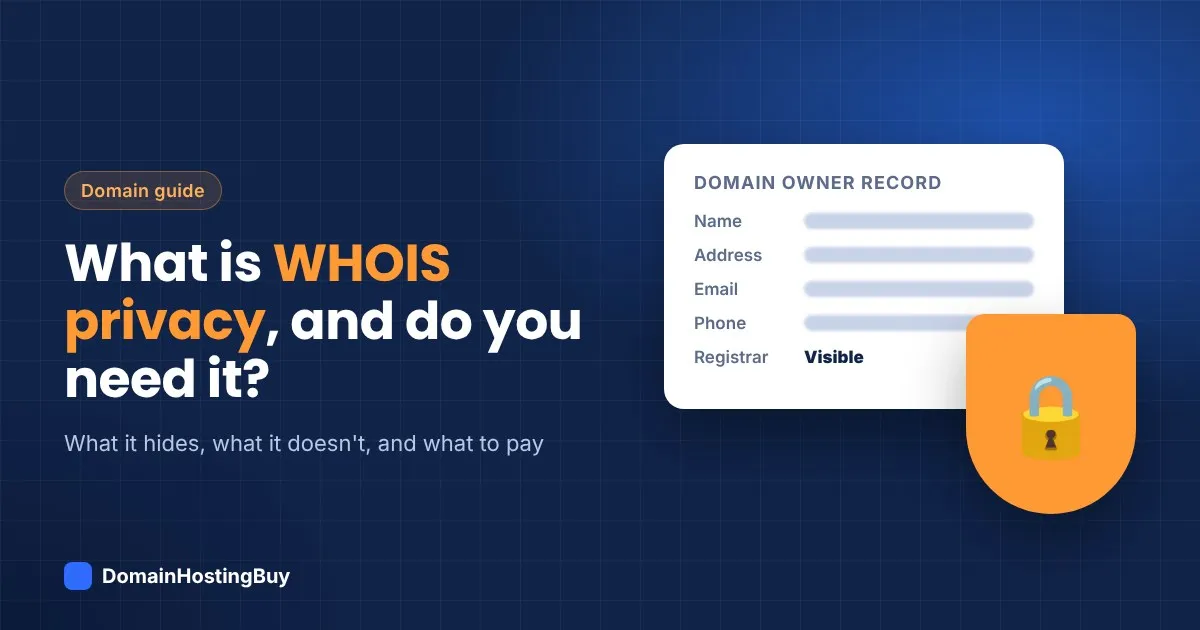
What Is WHOIS Privacy, and Do You Really Need It?
You are about to buy a domain and the checkout page asks if you want "WHOIS privacy" or "domain privacy protection". Sometimes it's free, sometimes it's a few dollars a year. What is it, and should you tick the box?
Short answer: yes, you almost always want it, and you almost never need to pay much for it.
What is WHOIS?
Every domain has an owner, and the domain system keeps a public record of who that is. For years this record was called WHOIS, and anyone could look it up. A basic WHOIS lookup used to show:
the owner's name and organisation
a postal address
an email address and phone number
the registrar and the domain's key dates
For generic extensions such as .com, a newer system called RDAP has largely replaced the old WHOIS service, but most people still call it WHOIS.
What does WHOIS privacy do?
WHOIS privacy replaces your personal details in that public record with the details of a privacy service. People who look up your domain see the service's name and a forwarding email address instead of your home address and phone number.
You still legally own the domain. Messages sent to the forwarding address can still reach you, so genuine contact is still possible.
Isn't my data hidden anyway now?
Partly. Since European privacy law (GDPR) came in in 2018, many registrars hide personal details by default. But not all registrars do it for every customer, and not every extension follows the same rules. Privacy protection makes sure your details are hidden, whatever the default.
Why you probably want it
Less spam. Public domain records are scraped by bots. Owners without privacy often get "your domain is expiring" scam emails, fake invoices and sales calls within days.
Safety. If you run a site from home, you probably don't want your address public.
Fewer scams. Fewer people know who owns the domain, so fewer people try to trick you into "renewing" with them.
When you might skip it
A registered company that wants its business address visible for transparency.
Some country extensions don't allow privacy services at all. For example, .us requires real owner details.
Some extensions already hide personal data by default under their own rules.
Should you pay for it?
Ideally, no. Many registrars, including Porkbun and NameSilo, include WHOIS privacy free with most domains. Others charge for it every year, which can quietly add to your total cost.
When you compare registrars, count privacy as part of the price. A domain that costs $1 less but charges $5 a year for privacy is not the cheaper deal. You can compare registrars side by side on our registrars page, and read our reviews of NameSilo, Name.com and OVHcloud.
A few things privacy does not do
It does not hide who hosts your website. Anyone can see your hosting company's IP address.
It does not hide you from the law. Registrars can reveal owner details to authorities, or when there is a legal complaint.
It does not protect your domain from being stolen. For that, use a strong password, two-factor login at your registrar and the transfer lock.
How to check what your domain shows
Search for "RDAP lookup" or "WHOIS lookup", enter your domain, and see what appears. If your name, address or phone number is visible, log in to your registrar and switch privacy on. It usually takes effect within minutes.
Frequently asked questions
Does WHOIS privacy affect SEO?
No. Search engines don't rank sites lower because their domain records are private.
Can I turn privacy on after buying the domain?
Yes. You can switch it on or off at any time from your registrar's dashboard.
Will privacy stop me receiving important emails about my domain?
No. Your registrar always emails you directly at your account address. Only the public record is changed.
Bottom line: turn it on, and pick a registrar that includes it for free. Compare domain prices to find one.